
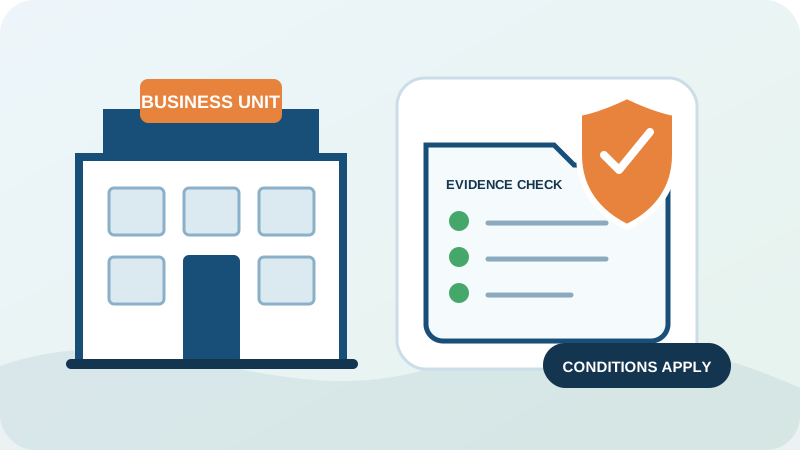
A practical guide to conditional commercial EPC exemptions, the evidence owners should retain and why an EPC exemption is not the same as a MEES exemption. This guide is written for practical decision-making and links to the sources used for verification.
Start with the EPC trigger, then test the exemption
A commercial Energy Performance Certificate is normally required when non-domestic premises are sold, rented out or completed after construction. It can also be triggered by specified changes to the number of separately occupied parts where fixed heating, air conditioning or mechanical ventilation is provided or extended. The seller or landlord should establish the correct position before marketing.
Exemptions are fact-specific. A familiar label such as ‘listed’, ‘warehouse’ or ‘small unit’ is not enough by itself. The owner should be able to demonstrate why the statutory description applies and keep the supporting evidence with the property file. Where the position is uncertain, obtain advice from an accredited non-domestic energy assessor and, where necessary, a solicitor or the relevant local authority.
The principal commercial EPC exemptions
GOV.UK identifies several categories that may not need a commercial EPC. Each has limits. A protected building is not automatically exempt merely because it is listed or sits in a conservation area; the test is whether complying with minimum energy-performance requirements would unacceptably alter its character or appearance.
The small-building exemption applies to a stand-alone building with total useful floor area below 50 square metres. Government guidance defines stand-alone as entirely detached. A 40 square metre shop forming part of a terrace or shopping centre does not meet that description simply because it has its own entrance.
- A temporary building planned to be used for two years or less
- A place of worship or building used for religious activities
- Certain industrial sites, workshops or non-residential agricultural buildings with low energy demand
- A stand-alone building with total useful floor area below 50 m²
- Certain protected buildings where the required changes would unacceptably alter character or appearance
- A building due for demolition where the detailed conditions are satisfied
Low-energy industrial and agricultural buildings
The wording concerns certain industrial sites, workshops and non-residential agricultural buildings that do not use much energy to condition the indoor climate. It should not be read as an exemption for every warehouse, garage, factory or farm building. Offices, heated production areas, customer facilities and other conditioned zones can change the analysis.
For EPC purposes, a building is a roofed construction with walls for which energy is used to condition the indoor climate. Fixed heating, mechanical ventilation and air conditioning are relevant services. A shell currently without fixed services may still require an EPC if such services are expected to be installed; the official methodology can use an assumed fit-out based on intended use.
- Record the actual use of each part
- Identify every fixed heating, cooling and ventilation system
- Separate low-energy workshop space from conditioned offices or amenities
- Confirm whether the premises are one building or several building units
Demolition requires more than an intention
An owner cannot normally rely on a future possibility of redevelopment. Official guidance sets detailed conditions around vacant possession, suitability for demolition and redevelopment, relevant planning and conservation consents, and reasonable grounds for believing that a prospective buyer or tenant intends to demolish the building.
Keep the planning decision, conservation or listed-building consents, marketing instructions and evidence of the proposed transaction. If the building may continue in occupation or the permissions are incomplete, do not advertise it as EPC-exempt without appropriate advice.
An EPC exemption and a MEES exemption are different
The EPC rules determine whether an energy certificate is required. The non-domestic Minimum Energy Efficiency Standard governs when certain privately rented property may be let below the required EPC rating. MEES has its own exemptions, evidence and registration process. Being unable to improve a low rating does not automatically mean the building never needed an EPC.
Conversely, if a property is genuinely outside the EPC requirement, do not assume that a MEES registration is the right document. Establish which regime applies first. Where a MEES exemption is needed, GOV.UK guidance explains the evidence and registration requirements; exemptions are not created merely by adding wording to a lease or marketing particulars.
Build a defensible property record
A professional decision record should identify the building or unit, transaction, floor area, fixed services, use, occupation arrangements and the precise exemption relied upon. Attach plans, photographs, planning evidence and any conservation advice. Recheck the position if the use, subdivision, heating or transaction changes.
Failure to make a required commercial EPC available can lead to a penalty linked to the building's rateable value, shown by GOV.UK as between £500 and £5,000. CertifyEPC can review the initial building details and arrange an accredited commercial assessment where an EPC is required.
Research and verification
Authoritative sources
Use these primary and specialist sources to check the current rule and read further.
Requirements can change and unusual properties may need specialist advice. Check the latest official source and the facts of the property before relying on a compliance conclusion.